
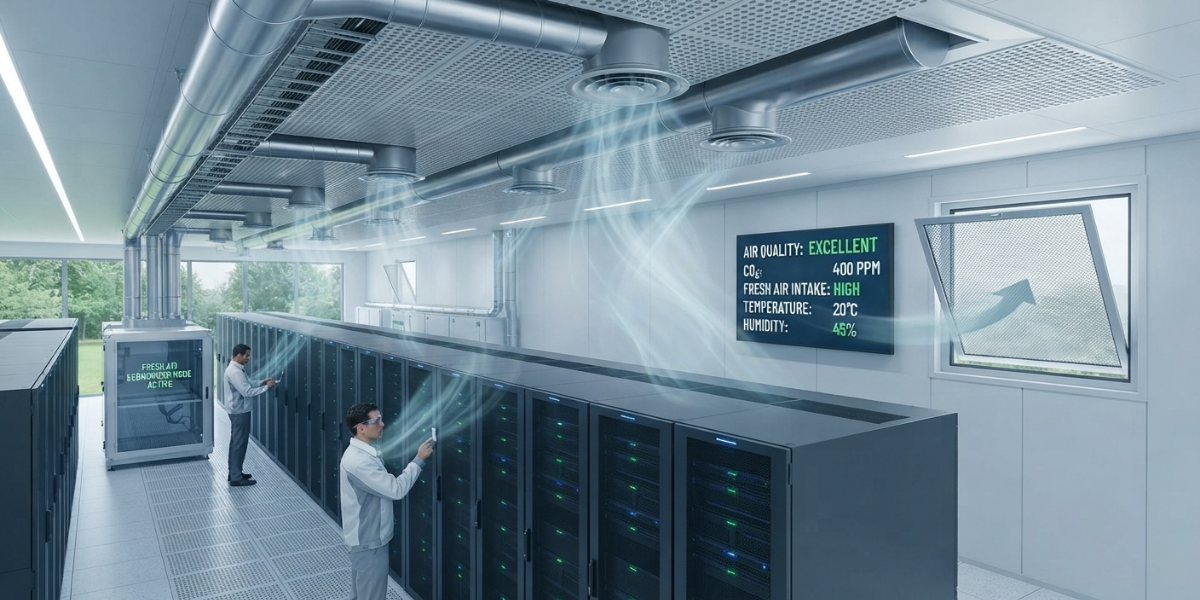
1. Reduces cooling load and PUE (Power Usage Effectiveness) – In favorable climates, fresh air (economizer-style) ventilation supplements or replaces mechanical cooling for part of the year, directly lowering one of the biggest cost lines in data center operations.
2. Removes heat generated by dense equipment racks – Servers, switches, and storage arrays generate continuous heat in a confined space. Controlled fresh air exchange helps maintain stable operating temperatures alongside CRAC/CRAH systems, reducing strain on cooling infrastructure.
3. Controls humidity within ASHRAE-recommended ranges – Both excess humidity (corrosion, condensation on equipment) and very low humidity (static electricity risk) damage hardware. Proper fresh air systems with humidity control keep conditions within safe operating bands.
4. Filters particulate matter that causes hardware failure – Dust and fine particles cause fan bearing wear, clogged heat sinks, and electrical short risk on exposed contacts. Filtered fresh air intake (not just raw outdoor air) protects sensitive components.
5. Reduces risk of corrosive gas damage – Industrial areas or polluted urban environments can introduce sulfur and chlorine compounds that corrode circuit boards over time. A properly filtered FAS keeps these contaminants out while still enabling air exchange.
6. Improves staff working conditions in server rooms – Engineers and technicians working in poorly ventilated server rooms face heat stress and stale air during maintenance windows. Fresh air systems make extended on-site work safer and more comfortable.
7. Supports redundancy and uptime SLAs — Ventilation issues causing localized hotspots are a real contributor to unplanned downtime. A well-designed fresh air/cooling combination adds a layer of thermal redundancy that protects uptime commitments.
8. Lowers risk of fire-related smoke and chemical lingering – In the event of a minor electrical or battery (UPS) incident, proper air exchange helps clear smoke and off-gassing faster, reducing secondary equipment damage from prolonged exposure.
9. Enables compliance with uptime and environmental certifications – Standards like Uptime Institute Tier ratings and ASHRAE TC9.9 thermal guidelines reference ventilation and environmental control as core criteria – a documented FAS approach supports these certifications.
10. Extends hardware lifecycle and ROI – Servers and networking equipment are major capital investments. Stable, clean, well-ventilated environments reduce thermal stress and contamination-related failures, extending usable hardware life and protecting that investment.
Bottom line for facility/IT infra heads: In data centres, ventilation isn’t a comfort feature — it’s directly tied to uptime SLAs, hardware ROI, and energy cost per rack. Framing FAS as a PUE and uptime lever (not just an air quality add-on) is what resonates with this audience.